Leen Helmink Antique Maps
Antique map of Batavia by Peter Conrad
The item below has been sold, but if you enter your email address we will notify you in case we have another example that is not yet listed or as soon as we receive another example.
Stock number: 19799
Small ImageCartographer(s)
Peter Conrad
Title
Plan der Stad en 't kasteel Batavia
First Published
Amsterdam, 1780
This Edition
Size
64.7 x 36.8 cm cms
Technique
Condition
mint
Price
This Item is Sold
Description
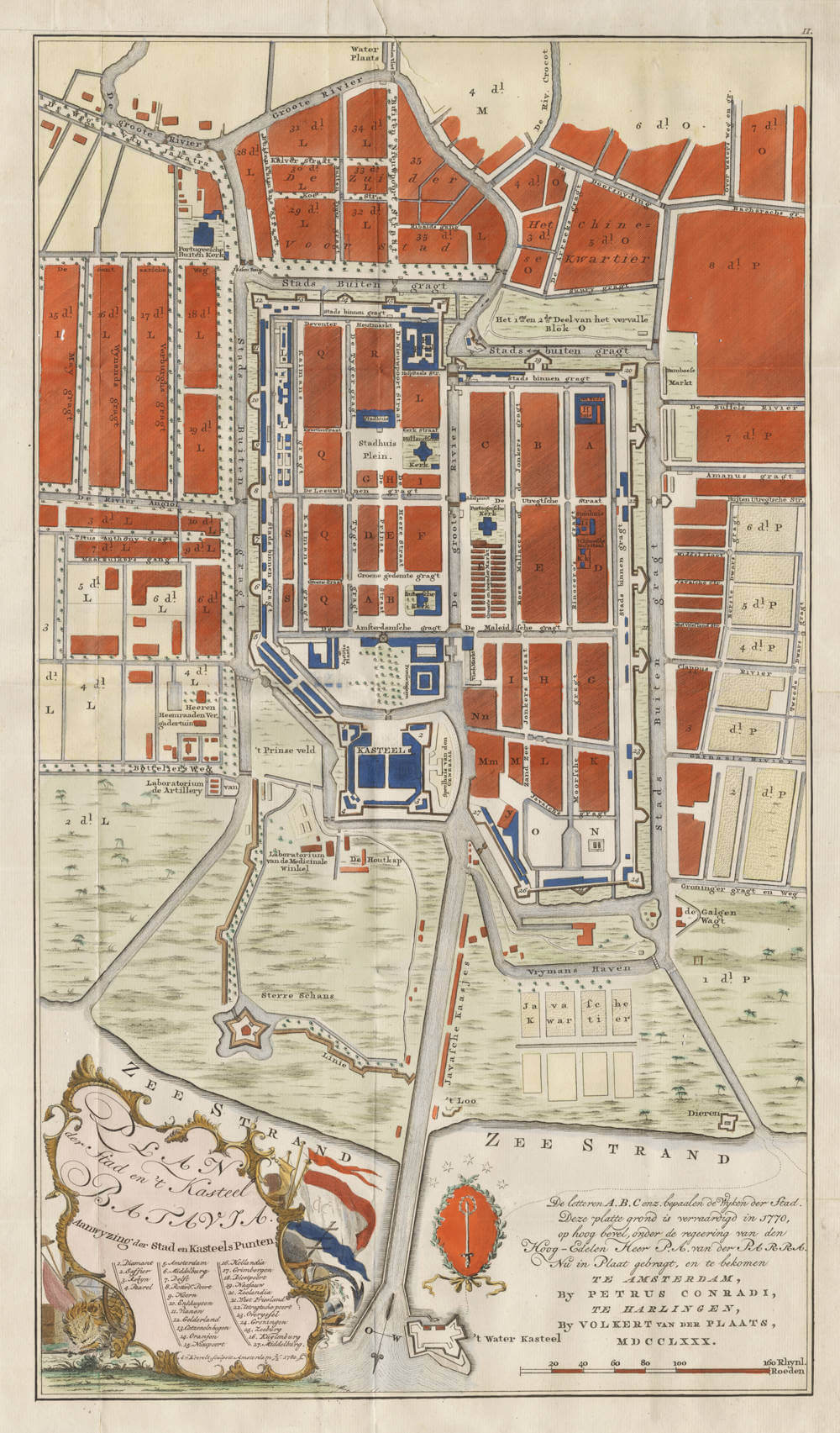
Peter Conrad's magnificent plan of Batavia at its zenith.
The 'Plan der Stad en 't kasteel Batavia' is a large engraved depiction of Batavia, the principal Dutch East India Company (VOC) settlement in Southeast Asia, now known as Jakarta, Indonesia. Produced in Amsterdam by Peter Conrad (Petrus Conradi) in 1780, this copper engraving captures the urban layout and fortifications of the city during the late eighteenth century, a period when Batavia served as the bustling administrative and commercial hub of the VOC's Asian trade network.
Batavia was established in 1619 by Governor-General Jan Pieterszoon Coen on the site of the destroyed port of Jayakarta, following the VOC's strategic imperative to secure a fortified base for the spice trade. The plan illustrates the city's characteristic orthogonal grid pattern, influenced by Dutch urban planning principles adapted to the tropical environment. A prominent rectangular walled enclosure defines the core urban area, intersected by a network of straight canals and streets that facilitated drainage, transportation, and defense in the marshy coastal plain of northwest Java.
As usual with maps of Batavia, the plan is oriented towards the south (-west), as seen from the seaport. Near the center, overseeing the roadstead, Kasteel Batavia (Batavia Castle) dominates the composition, depicted as a robust bastioned fortress with four corner bastions, moats, and ravelins, underscoring its role as the administrative heart and primary defensive structure. Surrounding the castle are key institutional buildings: the Governor-General's residence, council chambers, churches including the Nieuwe Kerk (New Church), warehouses (godowns), and the VOC hospital (known as the moordkuil or murder pit, named so because of the slim odds of survival). The plan meticulously delineates residential quarters, markets, and public squares, with hundreds of individual structures rendered in a stylized plan that allows for clear identification of architectural details such as roofs, towers, and gardens.
The engraving is signed by A. van Krevelt and employs a fine line technique typical of late eighteenth-century Dutch cartography, with hachuring for relief on the surrounding landscape, including low hills and the Ciliwung River estuary. A decorative title cartouche in the lower left features maritime motifs, while a scale bar in Rhineland rods and a compass near the bottom facilitate the interpretation. Explanatory keys, numbered from 1 to 27, identify significant landmarks such as the Portuguese Church, the Japanese quarter, Chinese kampongs, and military barracks, reflecting Batavia's multicultural populace comprising Europeans, Eurasians, Chinese merchants, and people from across the Indian Ocean world.
Cartographically, Conrad's plan draws on earlier surveys, possibly incorporating data from VOC engineers and updated observations up to the 1770s. It documents the city's expansion beyond the original walls, with suburbs (vorsteden) extending westward along the river, including the affluent Tanah Abang and Glodok areas. Fortifications are shown in detail, with demi-lunes, covered ways, and glacis, indicative of Vauban-inspired trace italienne designs adapted for insular defense against regional rivals like the Mataram Sultanate and British interlopers.
This map holds significant historical value as a visual record of colonial urbanism at its zenith, prior to the decline precipitated by the Fourth Anglo-Dutch War (1780–1784) and subsequent British occupations. It illustrates the interplay of commerce, governance, and imperialism, with wharves and shipyards along the waterfront highlighting Batavia's maritime orientation. Conrad, active as a publisher in Amsterdam, contributed to a tradition of VOC-related publications, rendering the exotic East accessible to European audiences through precise, informative imagery.
Scholarly references, including those in Tooley’s Dictionary of Mapmakers and standard bibliographies of Southeast Asian cartography, affirm its status as a standard reference for late VOC Batavia.
Rarity
The map is very rare, even more so in original colour. It is the first time in over 25 years that we can offer this map.
Condition description
The map is in stunning condition, with vibrant period hand-coloring on walls, buildings and water features, greatly enhancing readability. Printed on thick paper with wide margins. A very desirable collector's example of a showcase map of Batavia.
Related Categories
Related Items