Leen Helmink Antique Maps
First edition title page of Willem and Joan Blaeu's New Atlas of the World
The item below has been sold, but if you enter your email address we will notify you in case we have another example that is not yet listed or as soon as we receive another example.
Stock number: 19835
Zoom ImageCartographer(s)
Joan Blaeu (biography)
Title
Atlas Title Page
First Published
Amsterdam, 1635
Technique
Condition
mint
Price
This Item is Sold
Description
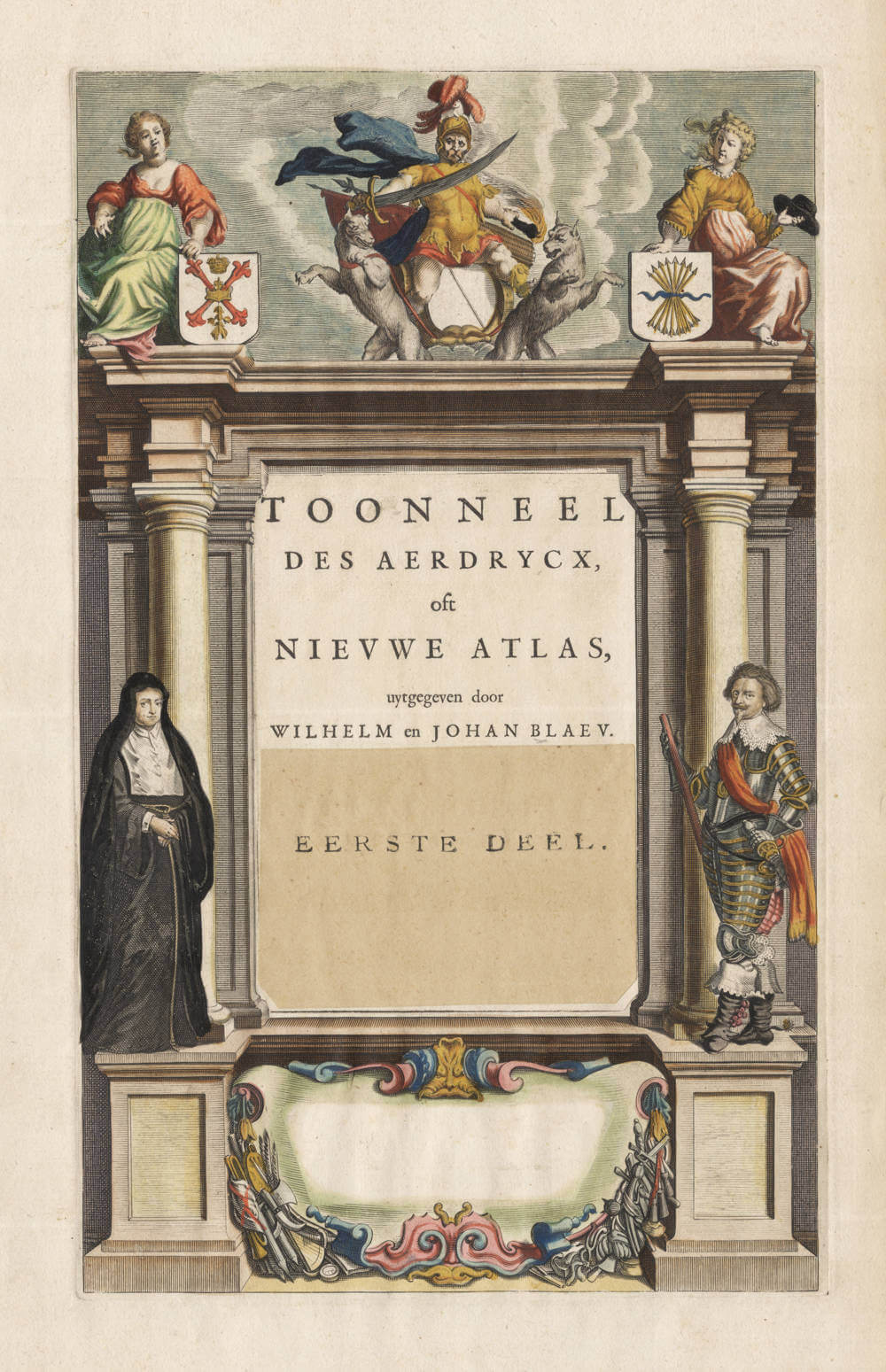
Title page of Toonneel des Aerdrycx, oft Nieuwe Atlas, published by Willem and Joan Blaeu. First volume (Eerste Deel). Amsterdam, 1635 first edition.
Engraved architectural title page to the first edition, first (incomplete) state, of the Toonneel des Aerdrycx, ofte Nieuwe Atlas (Amsterdam, 1635), published by Willem and Joan Blaeu.
The title page is designed as a monumental classical façade with fluted columns and entablature framing the engraved inscription:
TOONNEEL DES AERDRYCX,
oft NIEVWE ATLAS,
uytgegeven door
WILHELM en JOHAN BLAEV.
Pasted subtitle with typeset text:
EERSTE DEEL.
In this first edition, the atlas was issued in two parts. "Eerste Deel" (First Volume), as here indicated by separately typeset and pasted text, refers to Part I.
The modular typography reflects the expandable structure of the work at its inception. In this earliest state the large cartouche in the lower register remains incomplete; in later editions the copperplate was further engraved and the cartouche filled with the imprint: t'Amsterdam, By Johan Blaev. and the date, reflecting the evolving and increasingly monumental character of the publication.
Part I of the 1635 atlas was devoted to the Netherlands, conceived as the Seventeen Provinces, while Part II treated the rest of the world. The heraldic programme reinforces this conception. The shield at right displays the bundle of seven arrows emblematic of the Seven United Provinces, while the shield at left bears the crossed red batons associated with the Southern Netherlands that was still under Spanish Habsburg rule. Together they evoke the historic unity of the Netherlands despite contemporary political division.
Above the columns a martial allegorical figure is flanked by seated personifications holding the shields, while the side niches contain figures representing learned authority and martial protection: on the left, a woman in scholarly black dress, representing Cosmography or Philosophy; on the right, a military figure in armour with a musket, representing the art of War.
Issued in 1635, this title page marks the formal beginning of the Blaeu atlas enterprise. Its adaptable plate structure and modular design anticipate the steady expansion of the Nieuwe Atlas into multiple volumes, culminating in the monumental Atlas Maior (1662–1672). It stands at the starting point of the most ambitious atlas project of the seventeenth century.
Willem Janszoon Blaeu (1571-1638)
Joan Blaeu (son) (1596-1673)
Cornelis Blaeu (son) (?-c.1642)
Willem Janszoon Blaeu died in October 1638, leaving his prospering business to his sons, Joan and Cornelis, who continued and expanded their father's ambitious plans.
After the premature death of his brother Cornelis in 1642, Joan directed the work alone and the whole atlas series of 6 volumes was eventually completed about 1655. As soon as it was finished he began the preparation of the even larger work, the Atlas Maior, which reached publication in 1662 in 11 volumes (later editions in 9-12 volumes) and contained nearly 600 double-page maps and 3,000 pages of text. This was, and indeed remains, the most magnificent work of its kind ever produced; perhaps its geographical content was not as up-to-date or as accurate as its author could have wished, but any deficiencies in that direction were more than compensated for by the fine engraving and colouring, the elaborate cartouches and pictorial and heraldic detail and especially the splendid calligraphy.
In 1672 a disastrous fire destroyed Blaeu's printing house in the Gravenstraat and a year afterwards Joan Blaeu died. The firm's surviving stocks of plates and maps were gradually dispersed, some of the plates being bought by F. de Wit and Schenk and Valck, before final closure in about 1695.
(Moreland and Bannister)