Leen Helmink Antique Maps
Antique map of the World by Giovanni Antonio Magini
The item below has been sold, but if you enter your email address we will notify you in case we have another example that is not yet listed or as soon as we receive another example.
Stock number: 19807
Zoom ImageTitle
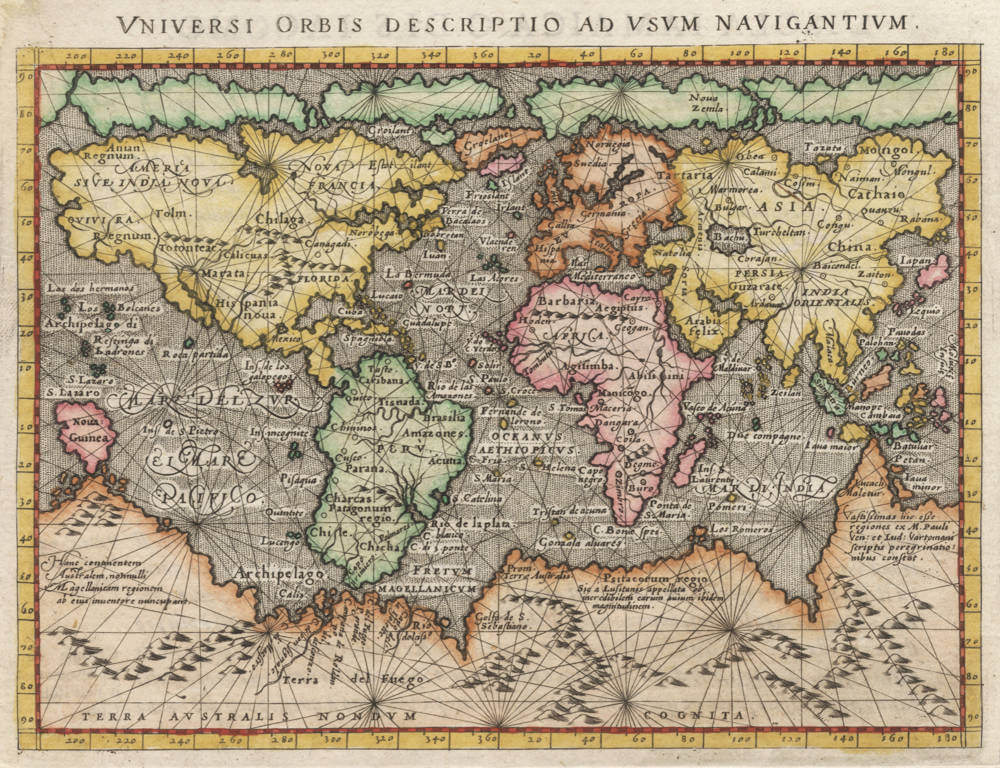
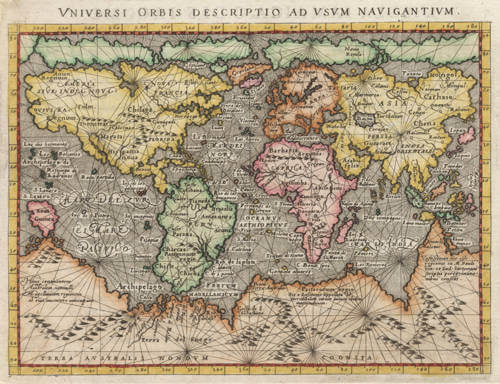
Universi Orbis Descriptio ad Usum Navigantium
First Published
Venice, 1597
Size
12.7 x 17.5 cms
Technique
Condition
excellent
Price
This Item is Sold
Description
Giovanni Antonio Magini's Universi Orbis Descriptio ad Usum Navigantium represents an important world map in the late sixteenth-century cartography.
Produced as the opening map in Magini's ambitious 'Geografia, cioè Descrittione Universale della Terra,' it is a reduced version of Gerard Mercator's 1569 wall map with revolutionary projection, here in one of the earliest applications of this system to a nautical chart.
The map is of particular significance and interest to the undiscovered South land, and has most of Mercator's explanatory annotations on it. Magini has embellished it with many imaginary mountain ranges.
Magini, a Bolognese mathematician, astronomer, and geographer (1555-1617), drew upon an extensive array of contemporary sources, including the latest reports from Portuguese, Spanish, and English explorers, to compile a synthesis of global knowledge circa 1596-1597.
The Mapping of the World
MAGINI’S mariner’s map follows Gerard Mercator’s large world map of 1569 on a much reduced scale and with the fanciful addition of chains of mountains across the southern continent. There are of course many fewer place names but the network of rhumb lines criss-crossing the map has been retained. The accompanying text below the map refers to navigational textbooks such as those by Pietro Medina, Giovanni Aurigario and Pietro Nonio, and gives simplified instructions to help seamen wanting to navigate from one place to another.
(Shirley map 196)
Giovanni Antonio Magini (1555-1617)
Giovanni Antonio Magini was one of the leading Italian cosmographers and mapmakers of the late sixteenth and early seventeenth centuries. Born in Padua in 1555, he studied mathematics and astronomy at the University of Padua, excelling in the rapidly developing sciences that combined classical knowledge with new geographical discoveries. His early fame came with his Ephemerides (1582), which established him as a skilled astronomer.
In 1588 Magini was appointed professor of mathematics at the University of Bologna, famously chosen over Galileo. Though based in Bologna throughout his career, he worked closely with Venetian printing houses, which at the time formed one of the most advanced European centre for engraving and atlas production. Venice provided the technical skill and commercial networks that made his cartographic projects possible.
Magini’s first major geographical publication, the Geographiae Universae tum Veteris tum Novae (Venice, 1596), was an ambitious re-edition of Ptolemy. Far more than a classical update, it included new regional maps and substantial commentary drawn from Spanish, Portuguese, and northern European sources. Its Venetian engravings aligned Magini’s work with the high standards of Ortelius and Mercator, then dominating the atlas market.
Alongside cartography, Magini wrote on trigonometry, cosmography, and astronomical instruments, producing works that linked geographical representation with celestial science. Yet his reputation today rests chiefly on his maps: the 1596 Ptolemaic atlas, which reasserted Italy’s presence in the European map trade, and the Italia, which became the standard printed mapping of the peninsula for more than a century.
Magini died in Bologna in 1617. His work marks the last great flowering of Renaissance Italian cartography before the full ascendancy of the Dutch.
Gerard Mercator (Kremer) 1512-1594
Arnold Mercator (son) 1537–1587
Rumold Mercator (son) c. 1545– c. 1599
Bartholomeus Mercator (son) fl. 1540-1563
Gerard Mercator (grandson) c. 1563-1656
Joannes Mercator (grandson) c. 1562-1595
Michael Mercator (grandson) c. 1567–1600
For nearly sixty years, during the most important and exciting period in the story of modern map making, Gerard Mercator was the supreme cartographer, his name, second only to Ptolemy, synonymous with the form of map projection still in use today. Although not the inventor of this type of projection he was the first to apply it to navigational charts in such a form that compass bearings could be plotted on charts in straight lines, thereby providing seamen with a solution to an age-old problem of navigation at sea.
His influence transformed land surveying and his researches and calculations led him to break away from Ptolemy conception of the size and outline of the Continents, Drastically reducing the longitudinal length of Europe and Asia and altering the shape of the Old World as visualized in the early sixteenth century.
Mercator was born in Rupelmonde in Flanders and studied in Louvain under Gemma Frisius, Dutch writer, astronomer and mathematician. He established himself there as a cartographer and instrument and globe maker, and when he was twenty-five drew and engraved his first map (of Palestine) and went on to produce a map of Flanders (1540) supervising the surveying and completing the drafting and engraving himself.
The excellence of his work brought him the patronage of Charles V for whom he constructed a globe, but in spite of his favour with the Emperor he was caught up in the persecution of Lutheran protestants and charged with heresy, fortunately without serious consequences. No doubt the fear of further persecution influenced his move in 15 s 2 to Duisburg, where he continued the production of maps, globes and instruments culminating in large-scale maps Europe (1954), the British Isles (1564) and the famous World Map on 18 sheets drawn to his new projection (1969). All these early maps are exceedingly rare, some being known by only one copy.
In later life he devoted himself to his edition of the maps in Ptolemy's Geographia, reproduced in his own engraving as nearly as possible in their original form, and to the preparation of his 3-volume collection of maps to which, for the first time, the word 'Atlas' was applied. The word was chosen, he wrote, 'to honour the Titan, Atlas, King of Mauritania, a learned philosopher, mathematician and astronomer'. The first two parts of the Atlas were published in 1583 and 1589 and the third, with the first two making a complete edition, in 1595, the year after Mercator's death.
Mercator's sons and grandsons, named above, were all cartographers and made their contributions in various ways to the great atlas. Rumold, in particular, was responsible for the complete edition in 1595. After a second complete edition in 1602, the map plates were bought in 1604 by Jodocus Hondius who, with his sons, Jodocus II and Henricus, published enlarged editions which dominated the map market for the following twenty to thirty years.
(Moreland & Bannister).
Related Categories
Related Items