Leen Helmink Antique Maps
渡海凱旋 - Crossing the Ocean in Triumph
Stock number: 18707
Zoom ImageCartographer(s)
Jia Quan (賈全) and Li Ming (黎明)
Title
渡海凱旋 / Crossing the Ocean in Triumph
First Published
Beijing, 1789
This Edition
1789
Size
51 x 88 cms
Technique
Condition
excellent
Price
$ 19,500.00
(Convert price to other currencies)
Description
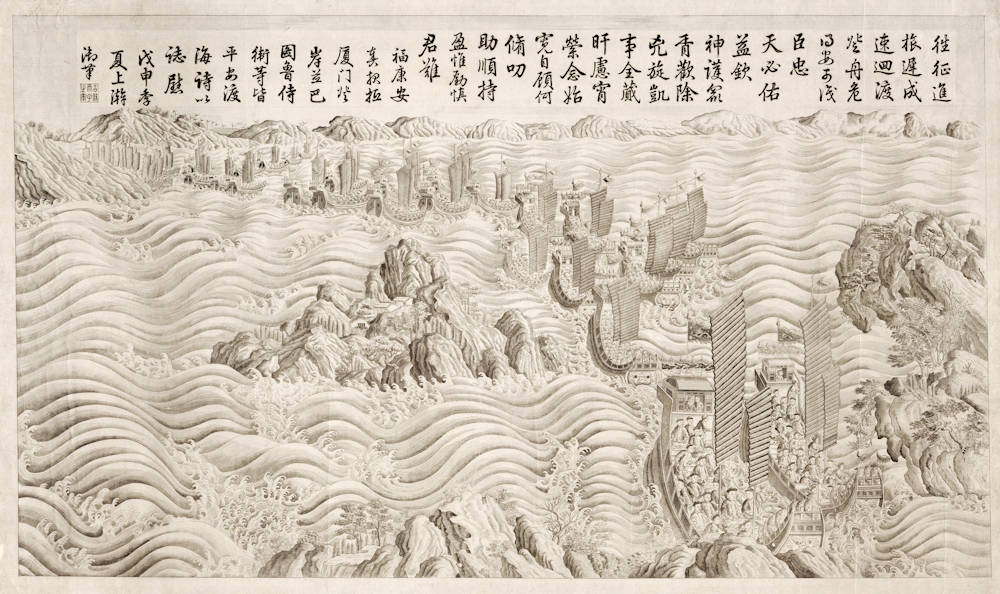
From the Pingding Taiwan desheng tu (平定臺灣得勝圖, "Pictures of the Victorious Pacification of Taiwan"), plate 11 in the Palace Museum sequence. Designs attributed to the court painters Jia Quan (賈全) and Li Ming (黎明). Engraved and printed at the imperial workshops (Neifu), Forbidden City, Beijing, 1789–1790. Copper engraving, 51 × 88 cm. Imperial poem in facsimile of the Qianlong Emperor's calligraphy, dated in the colophon to the first third of the last summer month of the wushen year (July 1788), with imperial seal.
The single maritime composition of the Taiwan suite, and its unrivalled showpiece: a fleet of war junks pitching through a sea of engraved swells that fills the entire sheet, carrying the victorious army home across the Taiwan Strait. On the horizon lies the coast of Taiwan. The rocky islets rising from the water at the left are the Penghu Islands (Pescadores), and the shore at the bottom and the right is the Chinese mainland, where the landing at Xiamen awaited. The engraved title records that the army "landed at Xiamen, the baturu guards and all the others having crossed the sea in safety," and the emperor's verses above, composed "to record my relief" within weeks of the events depicted, contrast the slow, hard-fought advance with the swift and heaven-favored crossing home.
The twelve plates of the series record the suppression of the Lin Shuangwen uprising of 1786–88, the largest rebellion of Taiwan's two centuries under Qing rule. Lin, a leader of the secret Tiandihui (Heaven and Earth Society), had seized much of western Taiwan and proclaimed his own reign era before the emperor dispatched Fukang'an, with the Manchu general Hailancha, at the head of a massive expeditionary force. Landing at Lugang late in 1787, Fukang'an broke the rebellion within months. Qianlong counted the victory among his "Ten Great Campaigns," and the present plate depicts its emotional close, the army safely returned across the water that had made this, uniquely among the ten, an overseas war.
The medium itself tells a story of exchange between East and West. Qianlong's first battle series, the Central Asian conquests, had been drawn by Castiglione and his fellow missionary painters and engraved in Paris in the 1770s. Meanwhile the French Jesuit Michel Benoist founded a copperplate studio within the palace itself in 1769, and after his death in 1774 his Chinese pupils carried the technique forward. The Taiwan suite, drawn by an all-Chinese team of court artists and cut and printed entirely in Beijing, represents the mature achievement of that workshop. The campaign was commemorated in three media, each with its purpose: watercolour albums for the archives; carved lacquer panels for the Ziguangge (Hall of Purple Splendour), where envoys of the tributary states waited for audience surrounded by images of Qing victories; and these engravings, the one reproducible medium, struck in small numbers for presentation to princes, high officials and the palace collections. Never sold commercially, the Taiwan plates survive in far fewer impressions than the Paris-engraved first series, whose reduced re-engravings by Helman circulated widely in Europe. Institutional holdings include the Palace Museum (Beijing), the National Museum of Taiwan History, the Musée Guimet, the Library of Congress and the Berlin State Library.
Market history
Individual plates from the Taiwan series appear on the market only at long intervals, and complete sets are rarer still. Sets have been sold at Sotheby's Hong Kong in 2003 (from the collection of Lord Elgin) and 2007; a complete set was estimated at $80,000 to 120,000 at Sotheby's New York in 2019; and the set from the library of Norman Bobins, bound as an album, realised £81,900 at Christie's London in July 2023. The present subject was offered by Paulus Swaen in 2014 and by Meijering Art Books in 2016.
Literature
Pirazzoli-t'Serstevens, Gravures des conquêtes de l'empereur de Chine K'ien-Long au Musée Guimet (Paris, 1969); Butz (ed.), Bilder für die "Halle des Purpurglanzes" (Berlin, 2003); von Spee, The Printed Image in China (British Museum, 2010); Reed, "The Qianlong Emperor's Copperplate Engravings," Harvard Library Bulletin (2017); www.battle-of-qurman.com.cn.
Rarity
The rarity of the Taiwan suite follows directly from how it was made and distributed. The Paris-engraved first series was printed in an edition of two hundred impressions per plate, half of them retained in Europe, and its imagery circulated more widely still through Helman's reduced re-engravings; the Beijing-made suites, by contrast, were struck only for imperial presentation, in small numbers, with no commercial edition of any kind. Complete sets of the Taiwan engravings are accordingly of the utmost rarity: beyond the set preserved in the Palace Museum, Beijing, and those in Berlin, only a handful have appeared at auction in the past half century. Partial holdings are recorded at the National Museum of Taiwan History (eight of the twelve subjects, including the present one), the Musée Guimet (three subjects) and the Library of Congress, from the Berlin State Library suite.
Condition description
Excellent imprint of the copper plate. Minor mellowing of the paper as always. Thick paper. Wide margins all around. No restorations or imperfections.
Related Categories
Related Items