Leen Helmink Antique Maps
Antique map of Nagasaki by Nagasaki-e, 長崎絵
Stock number: 18696
Zoom ImageCartographer(s)
Nagasaki-e, 長崎絵
Title
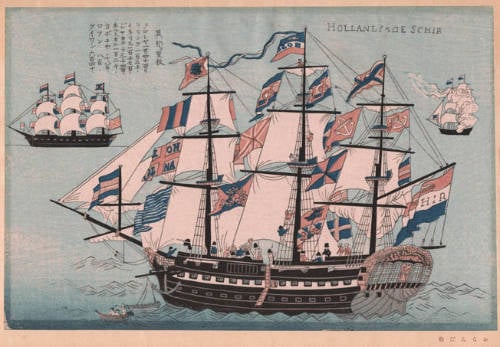
Hollandsche Schip / おらんだ船 (Oranda-sen)
First Published
Nagasaki, 1850
Size
21.5 x 32.5 cms
Technique
Condition
excellent
Price
$ 2,250.00
(Convert price to other currencies)
Description
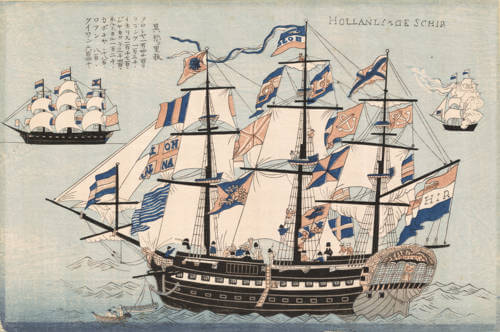
Hollandsche Schip / おらんだ船 (Oranda-sen)
Anonymous Japanese artist / publisher
Nagasaki, late Edo period, c. 1850
Colour woodblock print (nagasaki-e / 長崎絵) on paper.
A large three-masted, elaborately decorated Dutch East Indiaman (VOC-type merchantman) under full sail, with two similar vessels in the distance, one of them firing a salute in a cloud of smoke.
A small open Japanese sampan with figures in the foreground, to row people to and from the ship. The catted anchor hangs at the bow; a boarding ladder is lowered amidships. The main ship has a black hull with clear lines of gunports; from multiple ports the muzzles of the cannons are shown run out. The stern is richly ornamented, the deck is crowded with crew members in Western dress, most wearing hats, one holding a telescope. Two hornblowers amidships, sailors aloft in the rigging. The elaborately carved and gilded stern gallery, with a pictorial cartouche above glazed windows, a feature of the Dutch ships the Japanese found most remarkable.
The vessel flies an extravagant, largely imaginary display of flags and pennants, with crosses, anchors, wheels, crescents and stripes, including a Dutch tricolour at the mizzen lettered "H.I.P." (a corruption of SCHIP), a sail bearing a rose-coloured cross with mirrored letters "HO I / NA JO" (evidently a scrambled HOLLANDIA), and a masthead pennant with reversed pseudo-Roman letters. The title itself is scrambled, the block-cutter treating the unfamiliar Roman alphabet as pure ornament, garblings characteristic of authentic period Nagasaki-e (later reproductions tend to correct them).
Upper left: Japanese text listing distances from Nagasaki to various foreign countries (Russia, the Netherlands, England, Jakarta/Batavia, Portugal, Cambodia, Luzon, and Taiwan).
Rarity
Very rare. Nagasaki-e were popular inexpensive souvenirs sold to Japanese visitors to Nagasaki during the period of national seclusion (sakoku), when the Dutch were the only Westerners permitted to trade (confined to Dejima). Surviving examples in good condition are scarce because of the relatively thin paper and heavy contemporary use.
An essentially identical impression is held by the Kobe City Museum (阿蘭陀船), with the same Western title and provenance that includes the influential historian and C.R. Boxer ("The Dutch Seaborne Empire, 1600–1800", "The Portuguese Seaborne Empire, 1415–1825", "The Christian Century in Japan, 1549–1650", "Jan Compagnie in Japan, 1600–1817", "Portuguese Merchants and Missionaries in Feudal Japan, 1543–1640").
Significance
This rare late-Edo nagasaki-e print captures the Japanese fascination with the imposing Dutch East Indiamen that annually arrived at Dejima, serving both as a popular souvenir of the exclusive Dutch presence during Japan’s long period of national seclusion and as a vivid visual record of cross-cultural encounter.
Condition description
Excellent colour and impression. Trimmed to the printed border and loosely hinged with two paper hinges onto a larger backing sheet, that carries additional characters in the lower right (red Japanese, written right-to-left): おらんだ船 (Oranda-sen = “Dutch ship”).