Leen Helmink Antique Maps & Atlases
www.helmink.com
Bruegel
The Sailing Vessels
Certificate of Authentication and Description
This is to certify that the item illustrated and described below is a genuine antique
map, print or book that was first produced and published in 1565, today 461 years ago.
October 4, 2026
Cartographer(s)
Bruegel
First Published
Antwerp, 1565
This edition
Size
22 x 29 cms
Technique
Copper engravings
Stock number
19959
Condition
excellent
Description
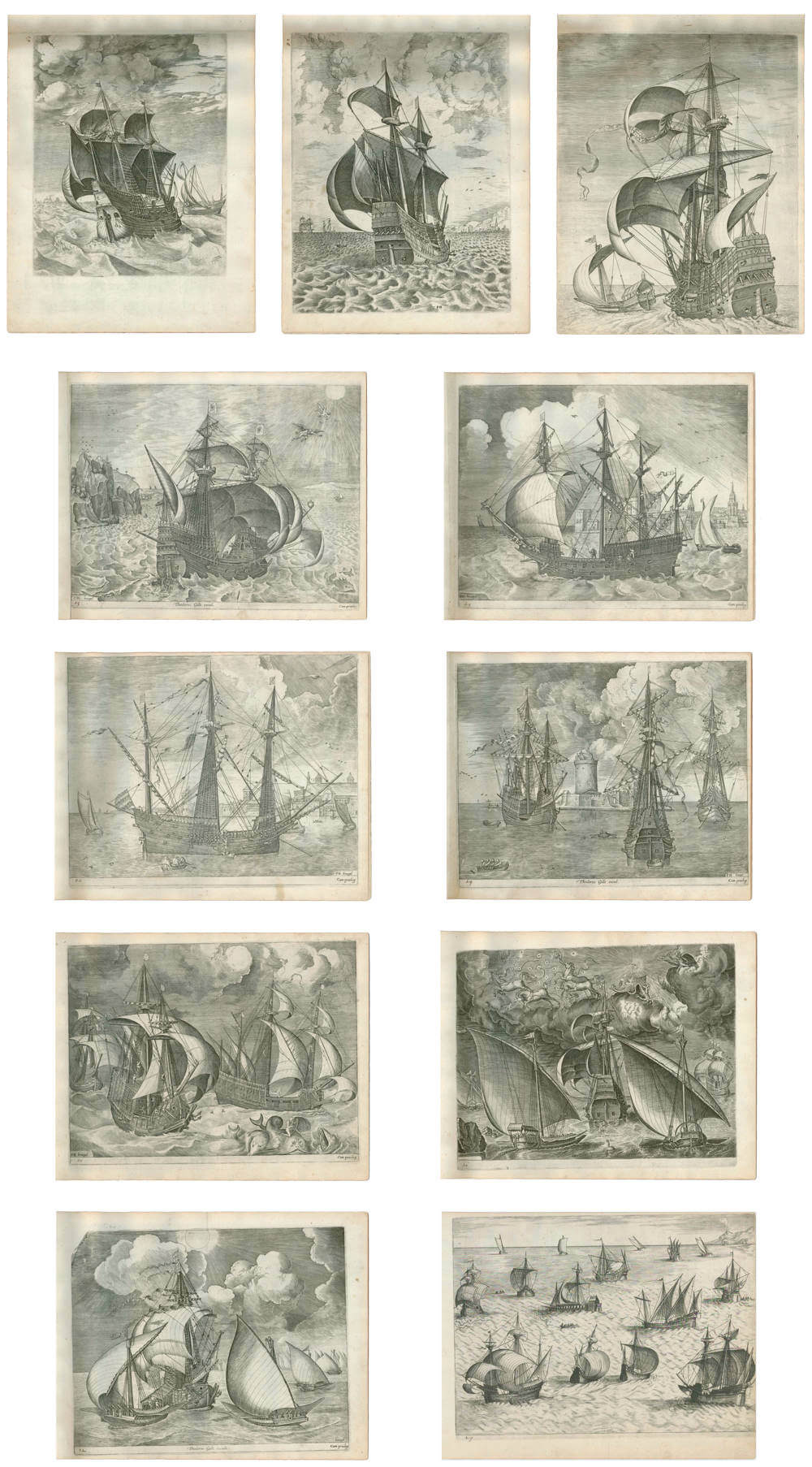
The Sailing Vessels, c. 1565
Masterpieces of marine art by Flemish artist Pieter Bruegel the Elder.
Of exceptional rarity and significance.
Second state. Mint condition.
THE COMPLETE SERIES OF ALL TEN PRINTS AS WELL AS THE (ELEVENTH) APOCRYPHAL OVERVIEW PRINT>
In style and technique the series resembles the large sea battle that Frans Huys engraved in 1561 after a design by Bruegel (Naval Battle in the Strait of Messina), and Bruegel’s detailed drawings are believed to have been made around the same time.
The importance of Bruegel’s ships’ portraits lies not only in their cultural and artistic value, but also in the precision that they provide. The ships are drawn in painstaking detail and are a source of information for marine historians to this day. They are “ship’s portraits” in the true sense. We have today little or no knowledge of the appearance, construction, and rigging of many vessels from this important maritime era in the history of discovery and exploration. The vessels depicted here with such power and detail by Bruegel were men of war right enough, and at the same time they were merchantmen whose routes and interests had to be safeguarded.
The series is of excellent quality and innovative in subject-matter and concept. Both Bruegel’s drawings and Huys’s technically superb engravings introduced a genre that was to remain popular in the Northern Netherlands well into the nineteenth century.
Added to the complete series of ten offered here is the legendary anonymous eleventh apocryphal overview or index print, attributed to Bruegel by van Bastelaer in 1908, rejected as a Bruegel by Lebeer in 1969, but attributed to Bruegel again by the New Hollstein in 2006. The mere fact that the apocryphal print forms part of this uniform set suggests that it indeed belongs to the series.
References:
René van Bastelaer, The prints of Pieter Bruegel the Elder, 98-107, 1908.
Louis Lebeer, Bruegel: The prints, 41-50, 1969.
The new Hollstein Dutch & Flemish etchings, engravings and woodcuts, 1450-1700 / Pieter Bruegel the Elder / compiled by Nadine M. Orenstein; edited by Manfred Sellink, 62-71, 2006.
The Sailing Vessels, c. 1565
The complete series of all ten prints as well as the eleventh apocryphal overview print
Frans Huys after designs by Pieter Bruegel the Elder
Copperplate engraving & etching, each c. 22 × 29 cm. Second state of two. Mint condition. Dark and even strike of the plates. Full margins on all sides, except for two of the plates which are larger than the others. A complete and homogeneous set.
Printmaker: Frans Huys (engraved on the plates) (Antwerpen ca. 1522 – 1576)
After designs now lost by: Pieter Bruegel (I) (engraved on the plates) (Bruegel (Breda) ca. 1525 – Brussel 5-sep-1569)
First state published by: Hieronymus Cock (engraved on some plates) (Antwerpen ca. 1518 – Antwerpen 10-mar-1570)
These second state published by: Theodoor Galle (engraved on some plates) (Antwerpen 16-jul-1571 – Antwerpen 8-dec-1633)
A complete and uniform suite of the most famous and dramatic of all 16th century maritime master prints, by Pieter Bruegel the Elder. The best old master prints of ships from the early era of discoveries and exploration. Many of these designs were copied by contemporary publishers like Abraham Ortelius and Gerard de Jode. Individual prints from this series are offered for sale occasionally, but complete homogeneous sets of all ten prints are impossible to find, because the prints were sold as loose sheets at the time. A number of museums have incomplete sets (Metropolitan Museum of Art, British Museum). The Rijksmuseum in Amsterdam has examples of all ten prints (from the legendary collection of Frederick Muller), but that collection is an assembled set, composed of sheets from different origin collected over the centuries.
The series of ten prints is known as the Sailing Vessels, executed by Frans Huys after designs by Pieter Bruegel the Elder. The series displays a wide range of sailing vessels, including merchantmen and warships, large seagoing vessels and small coasters, galleys, and caravels. The detail and painstaking accuracy with which the vessels are rendered attests to the artist’s great care and leaves no doubt that Bruegel must have prepared for the series by making numerous sketches and elaborate studies all of which unfortunately are lost. At what point in his life Bruegel became interested in the subject of ships is unclear, but the deep fascination the citizens of Antwerp took in it is understandable given the nature of the city’s economy. As a mercantile superpower with direct access to the North Sea, and as home to some of the most ambitious traders and explorers in Europe, Antwerp took great pride in the prowess and engineering of their ships and in their connection to the sea. Whatever the precise source of their appeal, Bruegel’s series of Sailing Vessels was a highly sophisticated creation that far surpassed previous examples of the genre in technique and imagination.
Condition
Strong imprints of the copperplates. Clean paper, no restorations or imperfections.
Pieter Bruegel I (c. 1525/30 – 1569)
Pieter Bruegel I (ca. 1525/30 – 1569), commonly known as Pieter Bruegel the Elder, was the greatest member of a large and important southern Netherlandish family of artists active for four generations in the sixteenth and seventeenth centuries. A longtime resident of Antwerp, the center of publishing in the Netherlands and a vibrant commercial capital, Bruegel brought a humanizing spirit to traditional subjects and boldly created new ones. He was an astoundingly inventive painter and draftsman, and, due to the continuity of the family trade and the industry that developed in prints after his works, Bruegel’s impact was widespread and long lasting. Born in or near Breda sometime between 1525 and 1530, Bruegel settled fairly early in Antwerp, where he became a master in the painters’ Guild of Saint Luke between 1551 and 1552. After a trip to Italy, he began a longstanding association with Hieronymus Cock, whose Antwerp publishing house, At the Four Winds, produced prints on a range of subjects, from parables to landscapes. Between 1555 and 1563, Bruegel made over forty designs for engravings, capitalizing on the strong market demand for images in the style or manner of Hieronymus Bosch (ca. 1453 – 1516). Bruegel’s Big Fish Eat Little Fish (1557, Vienna, Albertina) was even attributed to Bosch in Cock’s print, though all subsequent engravings were inscribed “Bruegel inventor.” The novel and ingenious way in which Bruegel translated moralizing subjects into vernacular language is most apparent in his original drawings and paintings, such as Netherlandish Proverbs (Berlin, Gemäldegalerie, Staatliche Museen), which depicts over 100 proverbs in the familiar setting of a Flemish village; it became one of the artist’s most popular images — at least sixteen copies of the painting are known. In religious or mythological depictions, such as the Fall of Icarus (Brussels, Musées Royaux des Beaux-Arts), Bruegel expanded the viewer’s perspective to make the titular action but one part of a startlingly broad vision of the natural and cultivated world.
A number of Bruegel’s paintings focus on the lives of Flemish commoners, which earned him the nickname “peasant Bruegel,” as well as the misguided reputation for being of peasant birth. In Kermis (Vienna, Kunsthistorisches Museum) and The Dirty Bride (a.k.a. The Wedding of Mopsus and Nisa), for instance, Bruegel depicts the boisterous activities of a country fair and a folk play, respectively, paying particularly close attention to the worn costumes and broad, emphatic gestures of the celebrants. But while these works demonstrate the artist’s attentive eye for detail and attest to his direct observation of village settings, they are far from simple recreations of everyday life. The powerful compositions, brilliantly organized and controlled, reflect a sophisticated artistic design. Bruegel was, in fact, patronized mainly by scholars, wealthy businessmen, and connoisseurs, and was on friendly terms with some of the most prominent humanists of the Netherlands, including the cartographer Abraham Ortelius and the publisher Christoph Plantin. The ongoing debate over the interpretation of Bruegel’s “peasant” images underscores the complexity and originality of his conception.
Bruegel’s use of landscape also defies easy interpretation, and demonstrates perhaps the artist’s greatest innovation. Working in the aftermath of the Reformation, Bruegel was able to separate his landscapes from long-standing iconographic tradition, and achieve a contemporary and palpable vision of the natural world. For the Antwerp home of the wealthy merchant Niclaes Jongelinck, who owned no less than sixteen of the artist’s works, Bruegel executed a series of paintings representing the Seasons, of which five survive: Gloomy Day, Return of the Herd, Hunters in the Snow (all Vienna, Kunsthistorisches Museum), Haymaking (Prague, Národní Galerie), and The Harvesters. Though rooted in the legacy of calendar scenes, Bruegel’s emphasis is not on the labors that mark each season but on the atmosphere and transformation of the landscape itself. These panoramic compositions suggest an insightful and universal vision of the world — a vision that distinguishes all the work of their remarkable creator, Pieter Bruegel the Elder.
He was an astoundingly inventive painter and draftsman, and, due to the continuity of the family trade and the industry that developed in prints after his works, Bruegel’s impact was widespread and long lasting.
(Jacob Wisse for Metropolitan Museum of Art)