Leen Helmink Antique Maps & Atlases
www.helmink.com
Ignaz Sichelbarth (Ai Qimeng), after
Benoît-Louis Prévost, engraver
平定伊犁受降 / Receiving the Surrender of the Ili
Certificate of Authentication and Description
This is to certify that the item illustrated and described below is a genuine antique
map, print or book that was first produced and published in 1769, today 257 years ago.
September 30, 2026
Cartographer(s)
Ignaz Sichelbarth (Ai Qimeng), after
Benoît-Louis Prévost, engraver
First Published
Paris, 1769
This edition
First issue
Size
52 x 90 cms
Technique
Copper engraving
Stock number
18706
Condition
excellent
Description
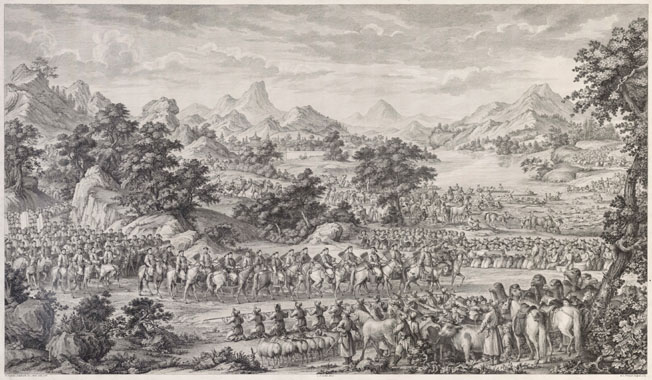
From the Pingding Xiyu zhantu ("Battle Pictures of the Pacification of the Western Regions"), the first of the suite of sixteen plates. After a drawing of 1765 by the Bohemian Jesuit court painter Ignaz Sichelbarth (Ai Qimeng, 1708-1780). Engraved in Paris by Benoît-Louis Prévost under the direction of Charles-Nicolas Cochin the younger, 1769. Copper engraving, 52 × 90 cm. First issue, printed in Paris for the Qianlong Emperor.
The opening image of the most ambitious printmaking project ever to pass between China and Europe. The scene is the submission of the Dzungar chiefs at Ili in 1755, the first act of the campaigns of 1755 to 1759 by which the Qing conquered Dzungaria and the Tarim oases and created the vast new territory the empire would call Xinjiang. Before the massed Qing cavalry and the general's standard, the chiefs of the Ili region kneel in surrender; the composition presents conquest as ceremony, the ideal image of empire with which the emperor chose to open the series. The sheet is signed in the plate: at lower left, P. Ignatius Sichelbarth Soc. Jesu delin. 1765; at lower right, B.L. Prévost sculpsit 1769; at center, C.N. Cochin direx. As issued the plate bears no engraved title, a characteristic of the Paris first issue, whose subjects were identified from the order of the suite and from the emperor's texts added later in Beijing; the familiar French titles derive from Helman's reduced versions of the 1780s.
The presence of this lettering is significant beyond identification. Most surviving impressions have been trimmed into the plate mark and have lost the credits along the lower edge, so that the individual designers can no longer be distinguished on the sheets themselves, and published attributions for the suite accordingly vary. The engraved line on this impression, corroborated by Takata's reconstruction of the four drawings despatched to Paris in 1765, one by each of the emperor's European court painters, establishes Sichelbarth's authorship of the composition from the object itself.
The sixteen plates reproduce monumental palace paintings made for the Ziguangge, the Hall of Purple Splendour, by the European artists serving the Qing court, Giuseppe Castiglione, Jean-Denis Attiret, Ignaz Sichelbarth and Jean-Damascène Sallusti. Requiring engraving of a quality China could not then supply, and himself an admirer of the battle prints of Georg Philipp Rugendas, the emperor had reduced drawings sent to Paris from 1765, where Cochin engaged the finest engravers in France between 1767 and 1774; Le Bas, Saint-Aubin, Prévost and Aliamet each took a plate in the first allocation of April 1767. The emperor asked for one hundred impressions of each plate; two hundred were pulled and divided between two ships, so that the full number would reach Beijing even if one were lost at sea, and the entire edition had arrived in China by 1775, the Compagnie des Indes being paid 240,000 livres for the undertaking. Only a very few surplus impressions were printed for the French king, his ministers and a handful of the court, with particular care that none was left in the hands of the engravers or printers. It is from that small residue, together with sheets taken at the sack of the Summer Palace, that the rare first-issue impressions in Western hands descend. It was, in scale, cost and distance, a printmaking commission without precedent, and the exchange it embodies, Chinese imperial imagery executed by the best engravers of Europe, has fascinated historians of both traditions ever since.
First-issue Paris impressions are consequently of great rarity, most of them now locked in institutional holdings, among them the Bibliothèque nationale, the Bibliothèque Mazarine, the Musée Guimet, Houghton Library, the Getty Research Institute, the Cleveland Museum of Art and the New York Public Library. The imagery is otherwise familiar only through the reduced re-engravings published by Isidore-Stanislas Helman in the 1780s, which gave the French public its picture of the Chinese emperor's wars. The companion plate from the same series, The Chief of Ush Surrenders with His City after Jean-Damascène Sallusti, is available separately; the pair may be acquired together at a preferential price.
Market history
Complete sets of the Paris issue appear on the market at intervals of many years. A complete set realised €181,000 at Christie's Paris on 29 October 2012, and a set in a modern binding realised €282,400 at Christie's London in July 2023, the same sale in which the Beijing-printed Taiwan suite made £81,900. Single plates are offered far less often than the set results might suggest, most surviving impressions being held in institutional collections.
Literature
Pelliot, "Les 'Conquêtes de l'Empereur de la Chine'," T'oung Pao 20 (1920-21), pp. 183-274; Fuchs, Monumenta Serica 4 (1939-40); Pirazzoli-t'Serstevens, Gravures des conquêtes de l'empereur de Chine K'ien-Long au Musée Guimet (Paris, 1969); Shaw, The Imperial Printing of Early Ch'ing China, 1644-1805 (San Francisco, 1984); Waley-Cohen, "Commemorating War in Eighteenth-Century China," Modern Asian Studies 30 (1996), pp. 869-899; Szrajber, "The Victories of the Emperor Qianlong," Print Quarterly 23 (2006), pp. 28-47; Torres, Les Batailles de l'Empereur de Chine (Musée du Louvre, 2009); Newby, "Copper Plates for the Qianlong Emperor: From Paris to Peking via Canton," Journal of Early Modern History 16 (2012); Takata, "Qianlong Emperor's Copperplate Engravings of the Conquest of Western Regions," Memoirs of the Toyo Bunko 70 (2012); Leverenz, "Drawings, Proofs, and Prints from the Qianlong Emperor's East Turkestan Copperplate Engravings," Arts Asiatiques 68 (2013); Reed, "The Qianlong Emperor's Copperplate Engravings," Harvard Library Bulletin 28 (2017); www.battle-of-qurman.com.cn.
Condition
A fine impression of the Paris printing, on heavy European paper with margins, retaining the full engraved lettering at the lower plate edge.